
Symbolism of a pearl

Beauty, Nature, Religion 31/05/2026 5 m

“Beauty is eternal; it is only that which is beautiful that changes.”

– Friedrich Schiller

The purpose of beauty is to evoke awe in the viewer, captivate him and enlighten him about the divine essence of life. Nature has countless ways to express beauty, be it through breath-taking landscapes of mountains, magical colors of sunsets, or intricate patterns of snowflakes. No matter what shape or form, beauty is the food for the soul. Therefore, it is essential for our emotional well-being to surround ourselves with it.

To our surprise, beauty is often found in places where we least expect it. Thus, in the depths of the ocean, hidden from sight, lies one of the most beautiful and precious gems in the world – the pearl. Its luster and mysterious origin have fascinated mankind throughout history.

The process of pearl’s creation in nature is very rare and long-lasting. It starts when a small irritant, sometimes as small as a grain of sand, enters into the mollusk and touches its soft tissue. To protect itself and reduce the irritation, the mollusk begins to envelop the irritant with layers of a bio-mineral that forms inside its shell. This mineral is called Nacre – also known as The Mother of Pearl.

This extraordinary process, which naturally occurs only once in every 10 000 mollusks and can last between 2 to 20 years, results in a small miracle – the pearl – an object of beauty, simplicity, and elegance. Its distinctive appearance and watery origin have inspired symbolism and lore for centuries.
BORN OF MOON AND WATER

Due to their close resemblance, many cultures have associated pearls with the Moon. Moreover, in all mythologies, the Moon is closely connected with water – the birthplace of pearls.

According to eastern mythology, a pearl taken from the oyster in whose shell it is formed is considered to be the concrete essence of the Moon. The pearls were seen as drops of the Moon-substance, which fell from the sky into the gaping oyster. That is why the pearl is considered to be the daughter of the Moon.

FEMININITY

In Chinese culture, the Moon is the root of Yin*, and Yin represents, among other things, the feminine energy.

* The Yin-Yang philosophy says that the universe is governed by a cosmic duality, a set of two opposing yet complementing principles or forces that can be observed in nature – light and darkness, Sun and Moon, male and female, etc.

Therefore, the pearls took on an important role for women – symbolizing femininity.

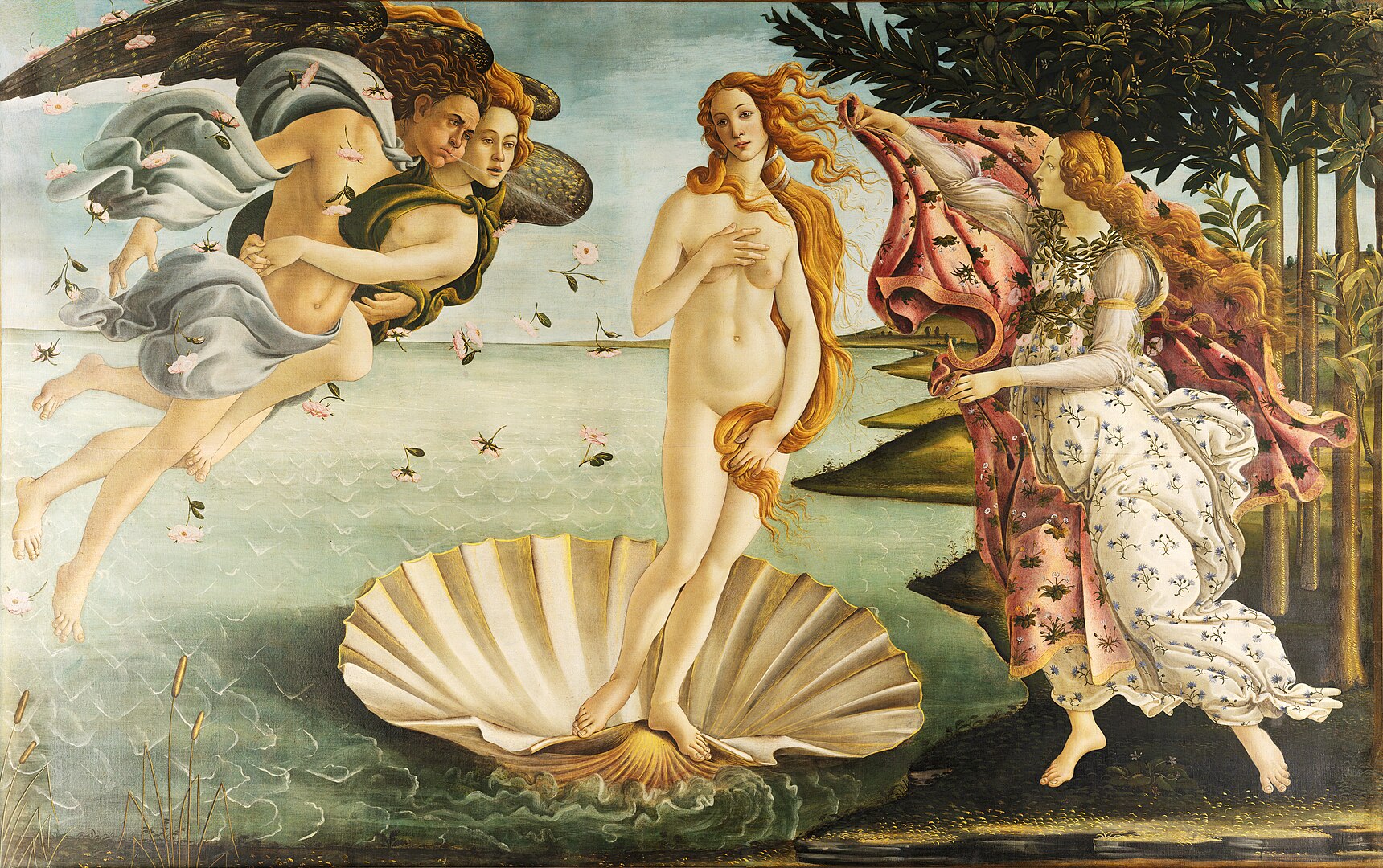
They also have astrological associations with the planet Venus, bearing the name of the Roman goddess. Venus, or Greek Aphrodite, the goddess of love, beauty, and fertility – appeared from the sea. Just like the pearls, she was born in a shell. This event is often beautifully depicted in art.

Sandro Botticelli, The Birth of Venus (c. 1484–1486). Tempera on canvas.

PEARLS OF WISDOM

Eastern philosophies see pearls as symbols of purity, perfection, and integrity. They are believed to attract wealth and luck as well as offer protection.

In Taoism, Buddhism, and Hinduism, pearls are objects of devotion and respect. They represent enlightenment and wisdom gained through experience. For this reason, we still commonly refer to precious advice and wise thoughts as pearls of wisdom.

THE PEARL IN CHRISTIANITY

In the Christian tradition, the pearl is above all a symbol of the Kingdom of God and of the incomparable treasure found in Christ. The Lord Himself says (Matthew 13:45-46):

Again, the kingdom of heaven is like a merchant seeking beautiful pearls, who, when he had found one pearl of great price, went and sold all that he had and bought it.

The pearl reminds us that communion with God is worth more than anything this world can offer. Like the merchant in the parable, we are called to seek the one thing truly necessary and to place the Kingdom of God above all earthly possessions and ambitions.

The formation of a pearl also carries profound spiritual meaning. Hidden within the depths of the sea, a pearl is formed – layer by layer – through patience, endurance, and transformation. In a similar way, the human being is purified through repentance, prayer, humility, love, sacramental life and perseverance in life’s trials. By God’s grace, suffering can become a means of spiritual growth and restoration, and what begins as a wound can be transformed into beauty.

For this reason, the pearl can be seen as an image of the renewed human person – one who is gradually transformed into a living reflection of God’s beauty. Created in the image of God, we are called to grow into His likeness, becoming ever more conformed to Christ. This journey of spiritual transformation, known in the Eastern Orthodox tradition as theosis, inspired the name of our blog: Growing the Pearl.

Hidden from the eyes of the world, the true treasure is not found in outward appearance, but in a heart united to Christ.